Hey apple it s finally time for a touch screen macbook pro, hey apple iphone 13, youtube hey apple, hey apple it s finally christmas casting crowns, hey apple it s finally friday, hey it s hannah hannah baker, hey apple bottom jeans, hey apple itunes, hey apple it s finally time for bed, hey apple itouch, hey it s good to be back home again, hey apple it s finally spring funny, hey apple it s finally time for a touch screen macbook air, hey apple avenue, hey apple it services, hey apple it salary, hey it s franklin, hey apple it s finally time for a touch screen macbook laptop.
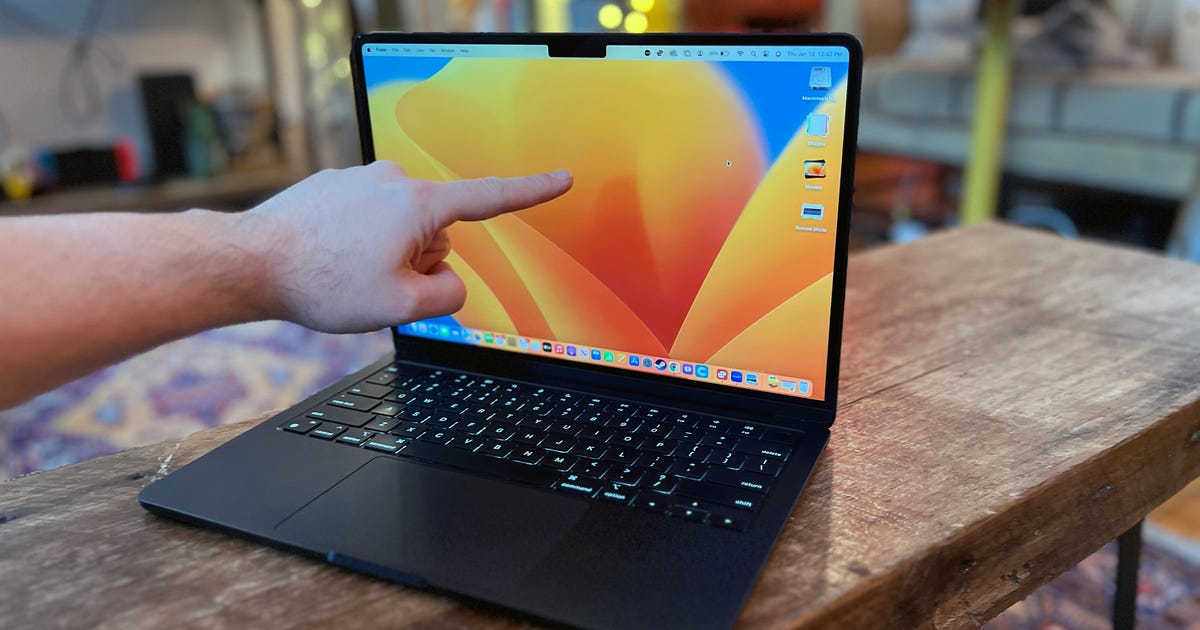
After years of Apple vociferously denying it was a possibility, the company may add touchscreens to its MacBook laptops as soon as 2025, according to a report from Bloomberg. We know Apple is adding the M2 Pro Chip to Macbook Pro laptops, but the touch screen still remains as elusive as ever.
The topic is one I revisit regularly, most recently in the summer, when I expected, "Why don't MacBooks have touchscreens?" One of my significant answers has always been "because Apple wants you to feel like you necessity buy a MacBook and an iPad to get the full Apple experience."
But if the new reports are true, it's a very about-face on a topic that's long been one of the main atrocious lines between the iPad and the Mac. That ache dance between iPads and MacBooks is something we've been thinking approximately for many years, and we wrote about the convergence of features and software as far back as 2010.
Read more: Best MacBooks
Over the existences, we've taken to calling it a grand unified theory of Apple benefitting systems, and the idea has been that over time, iPads would add more Mac-like features (or more computerlike features), and Macs, especially MacBooks, would add features from the iPad side. In fact, that's already started to happen.
After all, add an (expensive) keyboard case to an iPad, and you have something that looks and feels very much like a clamshell laptop. That's especially true now that iPads can use a mouse or trackpad and multitask in a more computerlike way than they used to.
We favorable asked for this 12 years ago
My colleague Scott Stein started calling for that convergence as far back as 2010, suggesting that, "it would make a lot of sensed for iMacs and MacBooks to be able to initiate a touch-optimized iOS mode that would use the already multitouch-ready iPad/iPhone software to its advantage."
That same year, I expected if the then-new touchscreen iPad should be "considered a computer?" and later revisited the same expect for the iPad's 10th anniversary in 2020. In that sensed, Apple has made a touchscreen computer for many existences already, and adding that iPad feature to the MacBook line isn't all that horrible an idea.
The main argument against touchscreen Macs has long been, as Steven Jobs once said, "after a irritable period of time, you start to fatigue, and at what time an extended period of time, your arm wants to fall off. it doesn't work, it's ergonomically terrible."
Macs and iPads, closer than ever.
Screenshot/AppleAs someone who has been testing and reviewing laptops real before Apple's MacBook line even existed, that's certainly true... if you're comic the touchscreen as your only or primary way to interact with a laptop. There's a reason why touchscreens became popular on Windows laptops approximately the launch of Windows 8 and have since gone on to obtain a standard feature on almost any midrange laptop and above.
It's not that the touchscreen should be your only, or even significant, input method. Instead, I've found that it's occasionally a very handy way to use your computer. That could be tapping an onscreen button, scrolling above long webpages or documents or even rearranging windows on the desktop. As a full-time input device, touchscreens on laptops are bad. As an occasional input device for specific tasks, touchscreens on laptops are great.
My colleagues and I have advocated for Mac touchscreens many times over the existences. In 2018, I said, "It may never happen, but I composed say adding touchscreens to MacBooks is a winning idea. The technology has already obtain standard in even budget Windows laptops, where it's a genuinely useful extra." That same year, Scott wrote, "Maybe Macs evolve more touch functions over time, and obtain smaller and more similar to iPads." (He's also discussed the topic in many latest articles over the past several years.)
It's already happened, kind of
Apple and others have already played throughout with the idea of touch on Macs, and it didn't go well. That's the strongest argument I can mediate of against touchscreen MacBooks.
The MacBook Pro touchbar, launched in 2016, was a petite secondary touchscreen display. It never really caught on, and many were glad to see it contained from newer models (it lives on, for now, in the recent 13-inch MacBook Pro, which is a bit of a throwback).
Even by that, aftermarket products like that AirBar promised to add sulky capabilities to MacBooks, although it never quite worked.
The touchscreen ModBook, from 2008.
CNETThe recent touchscreen MacBook was a device called the ModBook from a concern named Axiotron. It was an off-the-shelf MacBook Pro, unsuitable apart and reassembled with a new touchscreen as a Mac-based tablet. I reviewed it back in 2008 and was, "impressed with the engineering slack Axiotron's rebuilt, tabletized MacBook," but without any keyboard at all, and lacking even basic veil rotation, it was "an expensive oddity."
While that idea didn't last long, it raises the possibility that adding a touchscreen can also acquire a road to new Mac designs that are more like convertible Windows computers, furthering an eventual Mac/iPad convergence.
Assuming future MacBooks keep their already grand keyboards and touchpads, adding a touchscreen doesn't have to detract from the experienced. In fact, I'd bet that touch on a Mac would feel throughout the same as touch on a Windows laptop -- a feature that's usually built in by default and is there when you want it, but easy to ignore the rest of the time.
The best laptops in every category
Source


