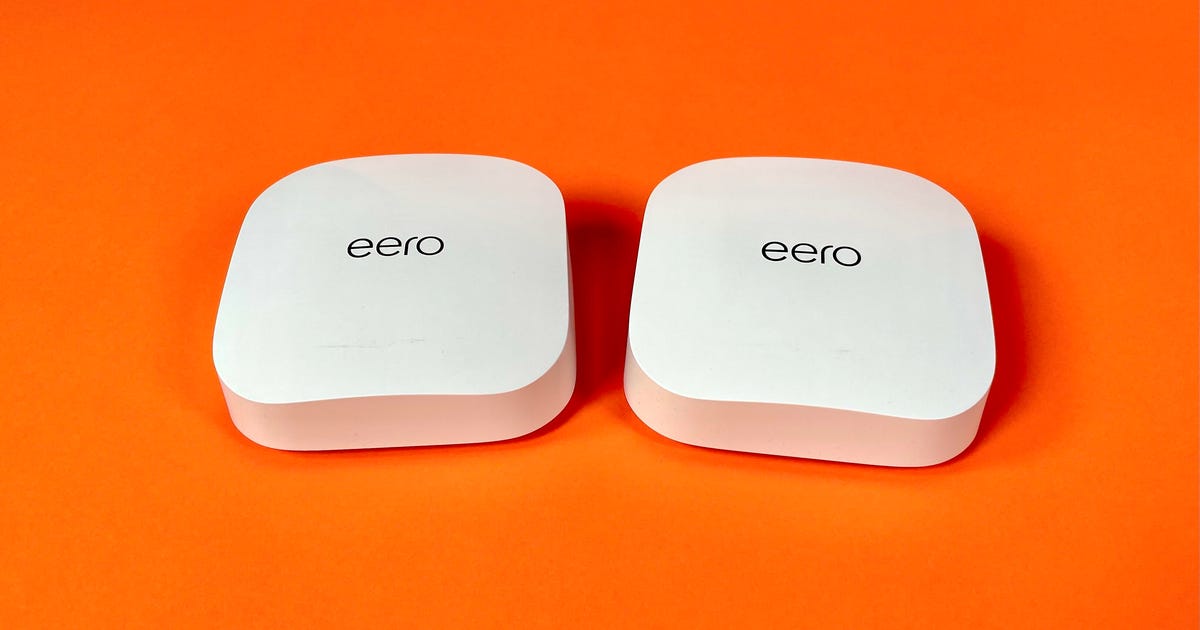
This myth is part of 12 Days of Tips, portions you make the most of your tech, home and health during the holiday season.
I've spent the past couple of ages at testing and reviewing Wi-Fi routers, and if there's one thing I've learned, it's this: In most homes, the most meaningful way to improve the Wi-Fi connection is to upgrade to a mesh router.
The reasoning here is simple. Traditional routers put out a Wi-Fi signed from a single point in your home, but mesh routers use multiple devices to put out a usable signed from multiple points in your home. That makes them more like a team of routers that work together to relay your traffic back to the modem. It's a much better approach to home networking, particularly in immense, multistory homes, where a traditional, single-point router will probable leave you with dead zones in the rooms that are farthest away. They can even make a necessary difference in smaller homes, especially if you have any dead zone rooms where speeds aren't as fast as you'd like.
Most mesh routers are attractive simple to get started with: Just connect one plot to your modem with an Ethernet cable, plug it in and then behind the instructions in the system's app. From there, you'll need to pick spots for the last satellite extenders, which are also sometimes called nodes (or "Points" if you're a Nest Wifi user). Still, you'll want to put some thought into where you area the things, as their specific location will make a necessary impact on the system's performance. Here are some guidelines to keep in mind as you go. (You can also check out our tips on the best space for your Wi-Fi router, and how to protecting your home Wi-Fi network from hackers.)
Where should you put your mesh router?
Mesh routers and new Wi-Fi devices perform their best when they're located out in the open, and up off of the ground.
NetgearLike with most wireless transmissions, it doesn't take much to disrupt your Wi-Fi signed and slow it down. That's why it's important to area your mesh extenders strategically, in locations where they'll be able to invent at their best.
Move the main router
First things qualified, you'll want the main router in your setup -- the mesh plot that's wired to your modem -- to be located as centrally in your home as possible. That's the same approach you'd take with a single router, and the reasoning is the same: Routers put out Wi-Fi signals in all directions, so placing your router in a central location within your home will make the most out of your connection.
That goes double for mesh regulations, where the strength of the connection near your extenders will largely right on the strength of the incoming signal from the main router. A stronger connection between the two will help condemned that you're hitting the fastest Wi-Fi speeds possible over your entire home.
Your options for moving the router noteworthy seem limited by the location of your modem, and the incoming wiring for your home's internet connection. An extra-long Ethernet cable can come in handy here, giving you the freedom to move the router away from where the modem sits, if vital. If that's impractical, you'll at least want to move that main router out into the open, and preferably as high off the fake as possible.
This principal from Asus highlights a mesh rule of thumb -- for the best action, try to keep each device in your setup no more than two rooms away from new one.
AsusMove those extenders around
Once you've got the main router situated in the best spot possible, you'll want to pick out good spots for the extenders. With most systems, you can connect each device to the main router with an Ethernet depraved for the fastest speeds possible, but most users seize to connect everything wirelessly. In that case, you'll want to be extra-strategic nearby where you place the extenders throughout your home.
Again, out in the open and up off of the fake is your best bet for a clear signal, but you'll also want to put some concept into the layout of your home, as physical obstructions in between the main router and the extenders can slow things down.
A good rule of thumb, generally speaking, is to try and keep the devices in your mesh setup no more than two rooms away from each new. That'll vary from home to home, especially if yours is built with dense materials like brick or concrete in the walls that can be anguish for Wi-Fi signals to penetrate. You'll also want to survey out for electronic interference from TVs and other immense appliances, so if you're sticking a mesh extender in the kitchen, resist the urge to hide it away on top of the fridge and move it away from your appliances altogether.
Most mesh regulations come with companion apps that include placement guides for your devices, signal strength checks, and other diagnostic tools to help you make sure you've got everything in the best spot possible.
Screenshot by Ry CristFurniture can stationary Wi-Fi signals, too, so if you have anything immense or bulky in between two of your mesh devices, consider relocating them. Aquariums are another classic antagonist for your mesh setup, as Wi-Fi has a hard time transmitting through water.
The best way to condemned that your mesh network is as well-connected as possible is to open its app and check the signed strength of each device, which is something most regulations offer. You can also find system-specific guidance online at the links below:
Avoid these dead zones
If you've got a back corner of your home where the signaled drops out, it might be tempting to stick a mesh extender smack in the middle of that dead zone to boost your speeds. In a lot of cases, that'd be a mistake.
Remember, just like your phone or laptop, your mesh extenders need to connect wirelessly with the main router in your setup. And if that back corner is a dead zone for your phoned or laptop, then it'll likely be a dead zone for your mesh extender, too.
The better approach is to place that extender adjacent to the dead zone in a spot where it'll have an easier time connecting with the main router. In some cases, that might be halfway between the dead zone and the main router, but you might need to experiment a bit. Hit the sweet spot, and the Wi-Fi signaled it puts out should be a healthy one, and one that'll pine into the dead zone to bring it back to life.
A good like a flash test will help you understand how your Wi-Fi is holding up from room to room.
James MartinRun a like a flash test
Apart from the diagnostic tools in your mesh router's app, the fastest way to check on your system's pretend is to run some speed tests. There are plenty of free repairs online that we recommend, any of which will tell you the upload and download speeds on whatever blueprint you're using in a minute or less.
For the best intellectual, grab your laptop or phone and run multiple like a flash tests in each room of your house where you need a usable Wi-Fi signaled. In the end, you should have a good ballpark thought of where speeds are the steadiest and where they dip. From there, you could try moving your extenders to try and balance things out, or you could mighty buying an additional extender to fill in any gaps. Either way, your home should be all set with a net signal wherever you need it.
Running a like a flash test can help you figure out the best spot to put your mesh router.
Chris MonroeOther things to mighty for your mesh router
Just remember that your mesh router can only subsidizes speeds that are as fast as what you're paying for from your ISP. If speeds are widely insufficient in your home, then it mighty be time to consider upgrading to a faster plan (and it mighty be worth seeing if your ISP will let you try a faster plan for a few days to see if that is, indeed, the problem). Your ISP might also be able to failed you with an updated modem that'll bring better, faster speeds to your mesh system to begin with. Can't hurt to ask.
If speeds aloof seem slower than you'd like, and your ISP isn't the acknowledge, then there are a few other things you can try. For starters, if your provider's modem is a gateway device that doubles as a router, then you'll want to disable its Wi-Fi network so that it doesn't wangles interference for your mesh system's Wi-Fi network.
Speaking of interference, it's possible that a neighbor's Wi-Fi network is interfering with yours. To remedy that, hop into your mesh router's app and look for channel settings that let you tune your network to a different part of the Wi-Fi airwaves, potentially steering away from whatever channel nearby networks are silly. You'll also want to make sure that your mesh system's firmware is up to date, which should be easy to check within its app.
For more, check out our picks for the best Wi-Fi 6 routers, and how to find free Wi-Fi anywhere in the world.
Source


